Watlala Village of the Cascades People
Kamagwaih – Cascade
Whylick Quiuck, Virginia Miller, Tumulth’s Daughter[1]Chuck Williams, a Cascade Chinook and direct descendant of Tumulth has Virginia as Tumulth’s daughter. Other researchers say her father was Tamakoun, a different Cascade chief who met Father … Continue reading
Edward S. Curtis (1868–1952)
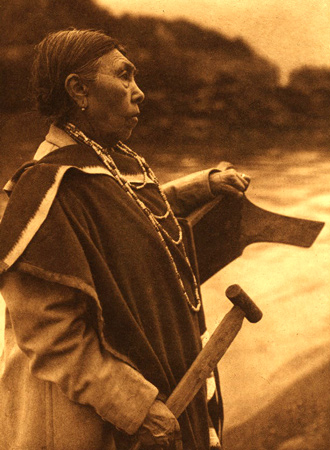
Courtesy Northwestern University Library, Edward S. Curtis’s “The North American Indian,” 2003. http://curtis.library.northwestern.edu/site_curtis.[2]Edward S Curtis, The North American Indian (1907-1930), vol. 8 (Cambridge, Mass.: The University Press, 1911), facing page 138.
Tamakoun’s Son (1841)
Joseph Drayton
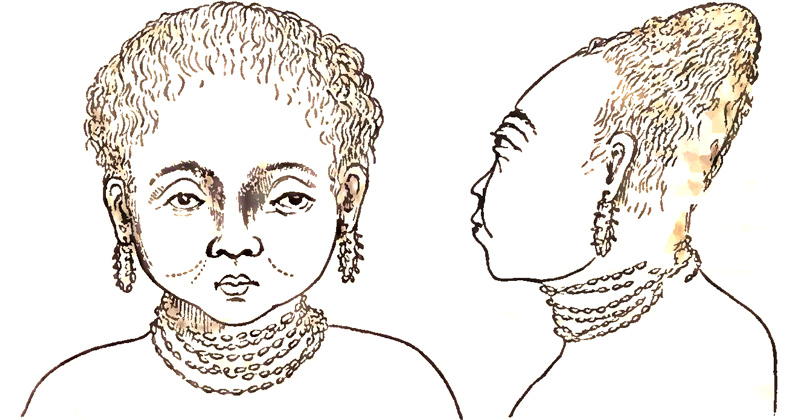
Woodcuts from a sketch by Joseph Drayton in Wilkes Narrative.
One of Paul Kane‘s subjects was Tamakoun (his To-ma-quin), a Cascade chief. Ethnographers David and Kathrine French, identify the chief’s son in an earlier sketch by Joseph Drayton, a member of the 1841 Wilkes Expedition.[3]David H. French and Katherine S. French, Handbook of North American Indians: Plateau Vol. 12, ed. Deward E. Walker, Jr. (Washington, D.C.: Smithsonian Institution, 1998), 371–72; Kenneth R. Lister, … Continue reading Of the child, Wilkes wrote:
Mr. Drayton obtained a drawing of a child’s head that had just been released from its bandages, in order to secure its flattened head. Both the parents showed great delight at the success they had met with in effecting this distortion.[4]Charles Wilkes, The Narrative of the United States Exploring Expedition During the Years [1838–1842] (Philadelphia: Lea and Blanchard, 1845), 4:388.
Watlala was the name of a key Upper Chinookan village at the Cascades of the Columbia. The name has been extended by many to mean the tribe more often called the Cascades. The captains called them the Shahala, meaning ‘those upriver.’[5]French and French, 375. The natural constriction of the river provided the people with a fishery and a good measure of control over those who traveled up and down the river. As a result, the Cascade Clahclellah village which the expedition visited on 31 October 1805 and 9 April 1806 was a major trade center before and during white contact.
In 1847, artist Paul Kane had time to observe and sketch several Cascade people and the submerged forest above the Cascades. He described the Cascade fishery and their method of collecting tolls from travelers:
We were engaged both days in carrying the parcels of goods across the portage, and dragging the empty boats up by lines. This is a large fishing station, and immense numbers of fish are caught by the Hudson’s Bay Company and the Cascade Indians, who congregate about here in great numbers at the fishing season, which happened at the time of our passing. They gave us a good deal of trouble and uneasiness, as it was only by the utmost vigilance that we could keep them from stealing.[6]Paul Kane, Wanderings of an Artist among the Indians of North America . . . (London: Longman, Brown, Green, Longmans, and Roberts, 1859), 259.
In the fall of 1805 and spring of 1806, the expedition had similar experiences with the Watlala. At that time, the tribe sold their fish not to an English trading company, but to other tribes. Forty years later saw the arrival of Oregon Trail settlers who hired the Cascades to steer their rafts through the rapids. Just a decade after that, a wooden railroad traversed the portage and steamboats on either end ferried passengers and goods along the river.
The 1855 Treaty
In 1855, Cascade leaders signed the 1855 Willamette Valley Treaty which listed the people as the “Wah-lal-la band of Tumwaters.” The treaty was ratified by Congress, and a majority of Cascades were moved to the Grand Ronde Reservation along with many other native nations from western Oregon. Others moved to the Yakama and Warm Springs reservations.
One of the treaty signers, Tumulth, was still at Watlala when Yakamas and Klickitats attacked Fort Rains in an attempt to block white trade through the Cascades of the Columbia. The Cascades maintained their innocence and did not flee when Lt. Philip Sheridan and his dragoons arrived. Sheridan held court and, according to oral tradition, if the defendant had recently fired his gun, he was declared guilty. Sheridan had Tumulth and eight other Cascades hanged. This was the beginning of the Plateau Indian War, Col. Steptoe’s defeat, and Gen. George Wright’s campaign of brutal retribution in Eastern Washington and parts of the Idaho panhandle.[7]Williams, 315–16; Donald L. Cutler, “Hang them all”: George Wright and the Plateau Indian War (Norman: University of Oklahoma Press, 2016), 93–94.
The Cascades Today
The Cascades Fishery
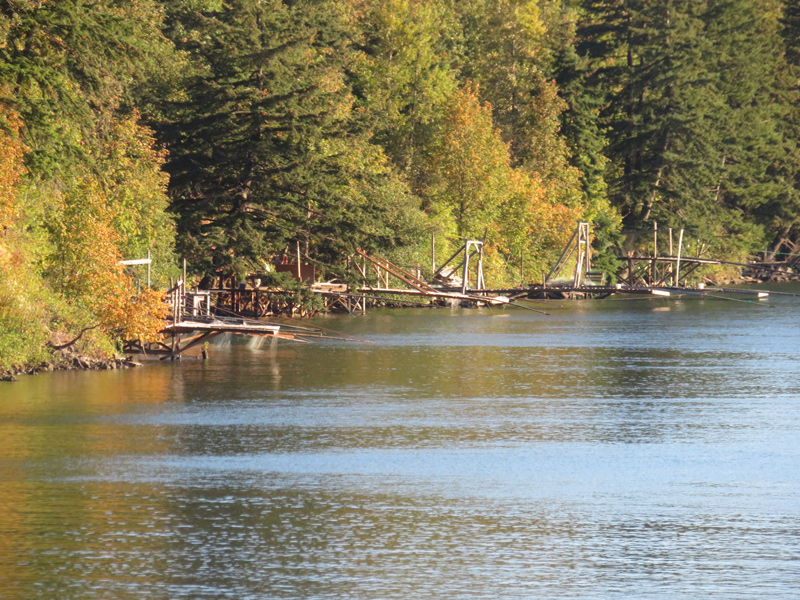
© 2022 by Robert Heacock. Used by permission.
Today, the Cascades maintain a fishery at the falls even though river is a reservoir behind Bonneville Dam. In the 1950s, the Bureau of Indian affairs declared the Grand Ronde Tribe assimilated and it was one of many Western Oregon Tribes terminated via the Western Oregon Indian Termination Act (PL 588). Many could not afford to purchase their allotments and had to move from the reservation. The federal government restored the tribe in 1983 leading to a resurgence of culture and community. Although Kiksht, the language of the Upper Chinook no longer has any speakers, the common Chinuk Wawa pigeon spoken among the diverse tribes living at the Grand Ronde Reservation has been preserved and is now taught.[8]French and French, 360; Robert H. Ruby, John A. Brown, and Cary C. Collins, A Guide to the Indian Tribes of the Pacific Northwest (Norman: University of Oklahoma Press, 2010), 379–80; David G. … Continue reading
Selected Pages and Encounters
October 31, 1805
Portaging the "Great Shute"
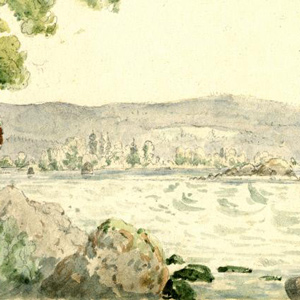
Clark and Pvt. Cruzatte scout the “Great Shute” at the Cascades of the Columbia, and two canoes are carried around the rapids. Clark continues down the river and sees a tall monolith—Beacon Rock.
November 1, 1805
A day with the Watlalas
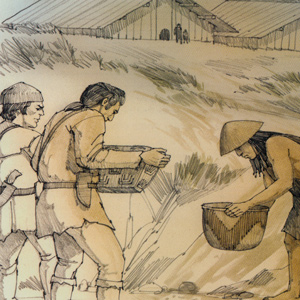
Most of the men move baggage and canoes around the Cascades of the Columbia. Clark describes the Upper Chinookan Watlala People living in the area, and Lewis adds Pacific madrone to his plant collection.
November 2, 1805
Last of the rapids
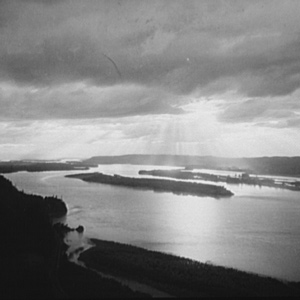
Non-swimmers carry baggage, and others paddle the empty dugout canoes though the lower rapids of the Cascades of the Columbia. They pass Beacon Rock and camp below present Crown Point in Oregon.
November 4, 1805
Busy day, noisy night
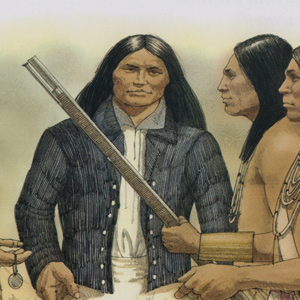
Moving down the Columbia River, a Chinookan villager introduces the captains to the wapato bulb—a staple Native food. At camp near present Ridgefield, Washington, they are kept awake by noisy waterfowl.
Up the Columbia
Heading home
by Barbara Fifer, Joseph A. Mussulman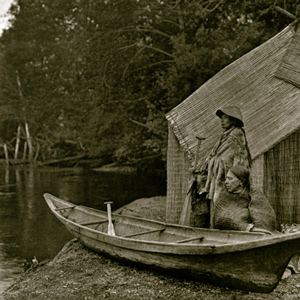
Homeward bound in April 1806, the Lewis and Clark Expedition traveled through the Columbia Gorge and pitched camps on its north side. Their passage was tense and unpleasant, with Indians taking small goods regularly.
March 30, 1806
Prospects for a settlement
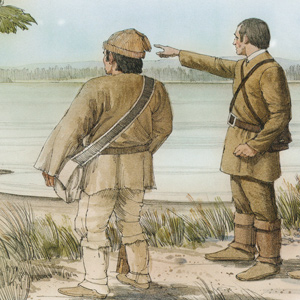
As they paddle through an area dense with Multnomah and Watlala villages, they see Cascade Mountain snow peaks, fertile land, and the best prospect for a large settlement west of the Rocky Mountains.
March 31, 1806
Provision Camp
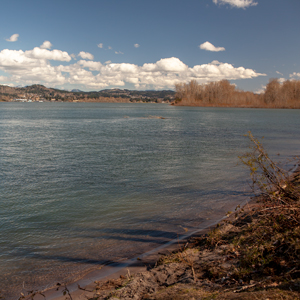
A multi-day basecamp is established to find the rumored “Waters of California” and to gather provisions. They learn that the missing river could be the as yet seen Willamette River.
April 1, 1806
Exploring the 'Quicksand' River
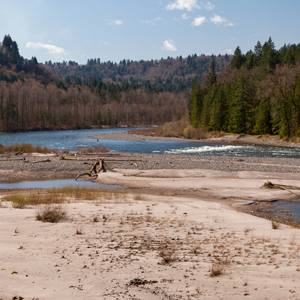
At Provision Camp, the expedition readies the hunt and makes new elk hide rope. Pryor’s detachment explores the Quicksand River—the present Sandy River in Oregon. Visiting Indians of various Nations warn there is no food upriver, and that the salmon will not come for another month. Lewis buys a Chinookan canoe for 6 fathoms of wampum beads.
April 2, 1806
Exploring the Willamette River
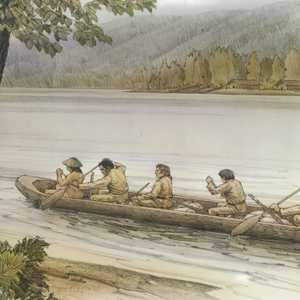
Clackamas visitors tell the captains about the Willamette River, and Clark sets out to find it. At a village at the that rivers’ mouth, Clark resorts to trickery to entice them to trade for food. At Provision Camp at present Washougal, Washington, Lewis says the berries are all gone except for the Oregon grape.
April 3, 1806
Mapping the Willamette River
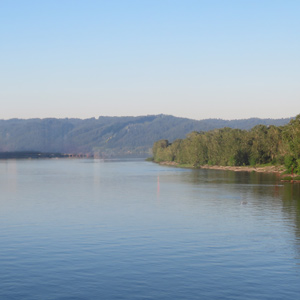
Clark concludes his exploration of the Willamette River. On his way back, he learns that a smallpox epidemic had devastated the local population. The group at Provision Camp at present Washougal, Washington are greatly outnumbered by starving Native People, and Lewis demonstrates the air gun as a defensive measure.
April 4, 1806
Hunting parties
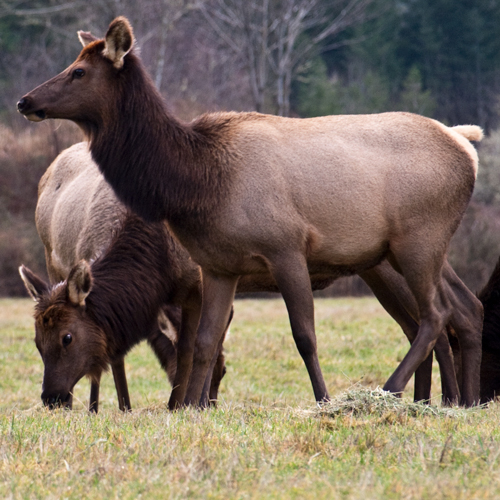
At Provision Camp near present Washougal, Washington, the captains coordinate various hunting parties. One group is sent up the Columbia River to hunt in advance of the main group. Many “parties of the natives” visit, and Lewis takes astronomical observations.
April 8, 1806
High winds, poor hunting
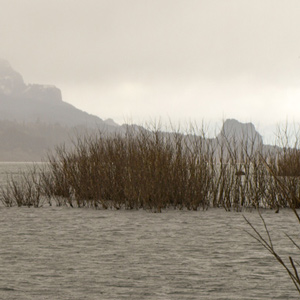
At present Shepperds Dell, Oregon, the dugout canoes are hastily unloaded before wind-driven waves fill them with water. On an evening walk, Lewis corrects an error he had made regarding salmonberry bushes. Late in the night, a thief is caught sneaking into camp.
April 9, 1806
Beautiful waterfalls
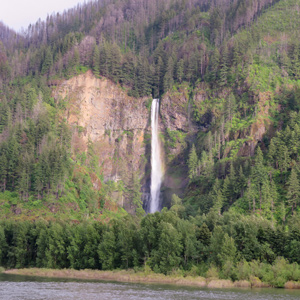
The expedition’s flotilla moves sixteen miles up the Columbia River Gorge marveling at its many beautiful waterfalls. In one of the villages, Pvt. Colter confiscates a tomahawk stolen the previous year.
In Washington City, the Secretary of War deals with the death of Arikara Chief Too Né who went there at the request of the captains.
April 10, 1806
To the Cascades of the Columbia
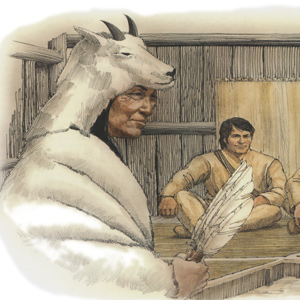
The men tow and ferry the dugout canoes to reach the portage around the Cascades of the Columbia. Before ferrying, Lewis collects a checker lily specimen on “Brant Island”. A canoe breaks loose, loses all its cargo, and is returned by local villagers.
In Washington City, President Thomas Jefferson seeks the name of the Arikara chief who recently died.
April 11, 1806
Lining the big chute

On this wet spring day at the Cascades of the Columbia, the men tow four dugout canoes through the “big Shoote.” Hostilities ensue when a few local Natives start stealing things. Even Lewis’s dog Seaman is stolen.
In Washington City, President Jefferson writes a letter to the Arikaras explaining Chief Too Né‘s death there.
April 12, 1806
A lost canoe
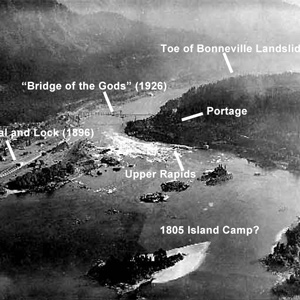
While towing the last and largest dugout canoe up the Cascades of the Columbia, a rope breaks and the boat is lost. To prevent thievery, the men arm themselves as they carry the baggage over the portage. Lewis enjoys a visit from some Watlalas who condemn their relatives who have been stealing expedition equipment.
April 13, 1806
New dugouts and dogs
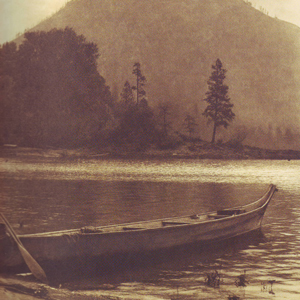
With only four dangerously overloaded canoes, the expedition continues paddling up the Columbia. Lewis buys two new dugouts from some Watlalas and rejoins Clark‘s group on the north shore near present Dog Mountain east of Stevenson, Washington. Lewis tells of his preference of dog meat over venison, elk, and horse.
Notes
| ↑1 | Chuck Williams, a Cascade Chinook and direct descendant of Tumulth has Virginia as Tumulth’s daughter. Other researchers say her father was Tamakoun, a different Cascade chief who met Father Blanchet in 1841 and converted to Catholicism. Chuck Williams, Chinookan Peoples of the Lower Columbia, ed. Robert T. Boyd, et al. (Seattle: University of Washington Press, 2013), 315–16. |
|---|---|
| ↑2 | Edward S Curtis, The North American Indian (1907-1930), vol. 8 (Cambridge, Mass.: The University Press, 1911), facing page 138. |
| ↑3 | David H. French and Katherine S. French, Handbook of North American Indians: Plateau Vol. 12, ed. Deward E. Walker, Jr. (Washington, D.C.: Smithsonian Institution, 1998), 371–72; Kenneth R. Lister, Paul Kane the Artist: Wilderness to Studio (Toronto: Royal Ontario Museum Press, 2010), 105, 154. |
| ↑4 | Charles Wilkes, The Narrative of the United States Exploring Expedition During the Years [1838–1842] (Philadelphia: Lea and Blanchard, 1845), 4:388. |
| ↑5 | French and French, 375. |
| ↑6 | Paul Kane, Wanderings of an Artist among the Indians of North America . . . (London: Longman, Brown, Green, Longmans, and Roberts, 1859), 259. |
| ↑7 | Williams, 315–16; Donald L. Cutler, “Hang them all”: George Wright and the Plateau Indian War (Norman: University of Oklahoma Press, 2016), 93–94. |
| ↑8 | French and French, 360; Robert H. Ruby, John A. Brown, and Cary C. Collins, A Guide to the Indian Tribes of the Pacific Northwest (Norman: University of Oklahoma Press, 2010), 379–80; David G. Lewis, et al., Chinookan Peoples . . ., 308–09; The Chinuk Wawa Dictionary Project, Chinuk Wawa: As Our Elders Teach Us to Speak It (Confederated Tribes of the Grand Ronde Community of Oregon, 2012). |
Experience the Lewis and Clark Trail
The Lewis and Clark Trail Experience—our sister site at lewisandclark.travel—connects the world to people and places on the Lewis and Clark Trail.

Discover More
- The Lewis and Clark Expedition: Day by Day by Gary E. Moulton (University of Nebraska Press, 2018). The story in prose, 14 May 1804–23 September 1806.
- The Lewis and Clark Journals: An American Epic of Discovery (abridged) by Gary E. Moulton (University of Nebraska Press, 2003). Selected journal excerpts, 14 May 1804–23 September 1806.
- The Lewis and Clark Journals. by Gary E. Moulton (University of Nebraska Press, 1983–2001). The complete story in 13 volumes.
This site is provided as a public service by the

Lewis and Clark Trail Alliance
with additional funding from the following:


